Production Agent-RAG Architectures
Introduction
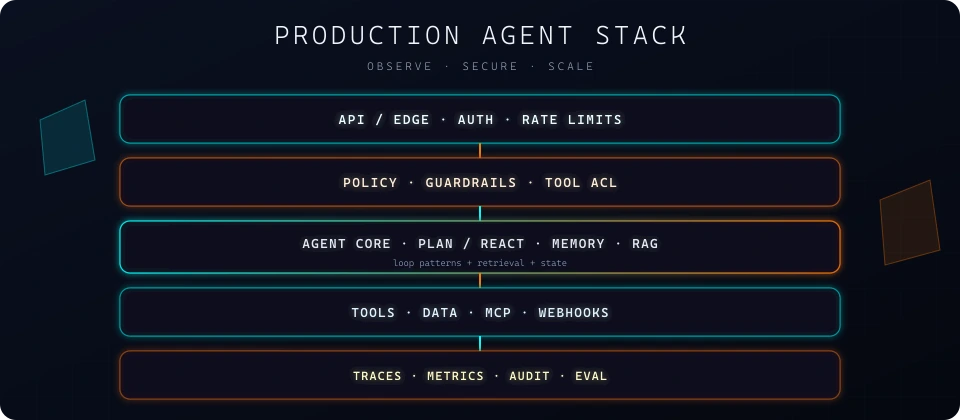
Agent loop patterns name the cycles (think–act–observe and extensions). This page focuses on one production stack: an enterprise knowledge copilot — how you combine RAG, optional ReAct, memory, and tools for grounded answers from approved sources.
The card below has a SOLUTION / STACK line and a deep dive on ingest, hybrid retrieval, rerank, augment, generate, and optional agent steps. For sense, think, act, observe, and finish, see Anatomy of an AI agent; for retrieval pipelines, Anatomy of RAG.
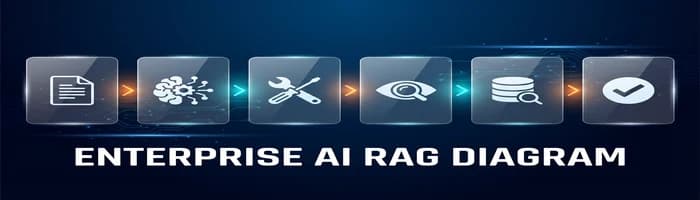
Enterprise knowledge copilot
The customer wants employees, partners, and customers to get fast, consistent answers from policies, handbooks, and product facts—without routing every repeat question through subject-matter experts. The product they need is an internal knowledge assistant: grounded in approved sources, permission-aware by role or tenant, and able to cite where an answer came from—not a generic chatbot that invents or pulls from the public web. Technically, that means answers from your private corpus with citations: retrieve first, then reason and act only when retrieval is not enough. Session memory keeps follow-ups coherent; tool allowlists keep writes rare or absent.
SOLUTION: AGENTIC RAG: RAG + RE-ACT(MULTI + SPEAK + PLANNING + REFLECTION) + MEMORY
Typical tools: vector search / file fetch, optional calculator or ticket creation with approval.
Patterns: ground with RAG before acting; keep memory scoped to session or tenant so facts do not leak across users.
When it fits: internal Q&A, policy lookup, onboarding assistants. Add multi-action only when lookups are independent (e.g. two knowledge bases).
Additional Ideas:
- Exponential backoff for retries
- Caching Strategies for performance
- FAISS is a compute library. The usual pattern: vectors stay in memory for queries; you can keep an optional index file on disk for reload; payloads are usually stored outside FAISS.
- Composition and decomposition of an agentic system into smaller pieces.
- Sharding or partitioning the database to speed up retrieval
- Some system components can run concurrently or in parallel
- Real-time; streaming
Conclusion
Pick the smallest stack that meets the use case: add planning, memory, or reflection when accuracy or horizon demands it — each layer adds latency and ways to fail. Ground with RAG when facts live outside the model; keep tool surfaces narrow for high-risk flows. More on risks and controls: Prompt injection, RAG architectures, Agent loop patterns.