
Caching is a fundamental technique for improving application performance by storing frequently accessed data in fast storage layers. Understanding different cache patterns and caching strategies is crucial for building scalable and efficient systems. This article explores cache patterns and common caching strategies that developers can implement.
Cache Patterns
Cache Aside
In Cache Aside pattern, the client never talks directly to the database. The application talks to both the cache and the database. On a cache miss, the application fetches data from the database and populates the cache.
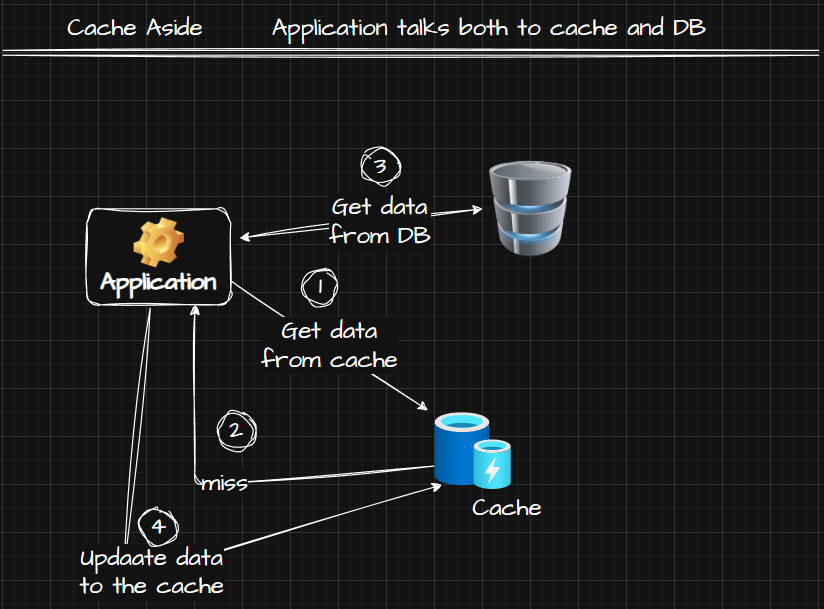
Characteristics:
- Application manages cache population
- Cache and database are independent
- Simple to implement and understand
- Requires careful cache invalidation logic
Read Through
In Read Through pattern, the application reads from the cache, which automatically reads from the database on a miss. This pattern supports preheating or preloading the cache with data before it's requested.
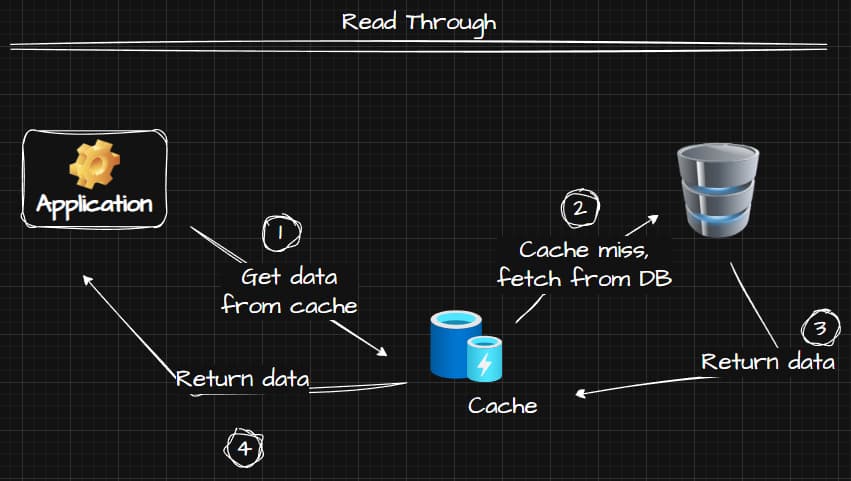
Characteristics:
- Cache layer handles database reads automatically
- Supports proactive cache warming
- Application only interacts with cache
- Cache layer becomes more complex
Write Through
In Write Through pattern, the application writes to the cache, which writes to the database every time. This ensures strict consistency where cache and database are always in sync, making it better for read-heavy workloads.
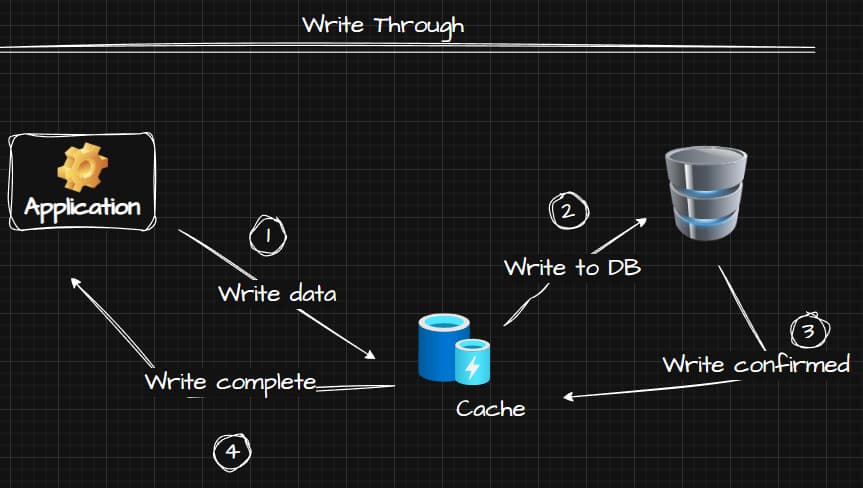
Characteristics:
- Strict consistency between cache and database
- Cache and database always in sync
- Ideal for read-heavy applications
- Higher write latency due to dual writes
Write Back
In Write Back pattern, data is always written to the cache, and the database is updated occasionally. This provides high write throughput and is ideal for handling large volumes of writes efficiently. It offers eventual consistency and works best for heavy write workloads, though it can also benefit read performance.
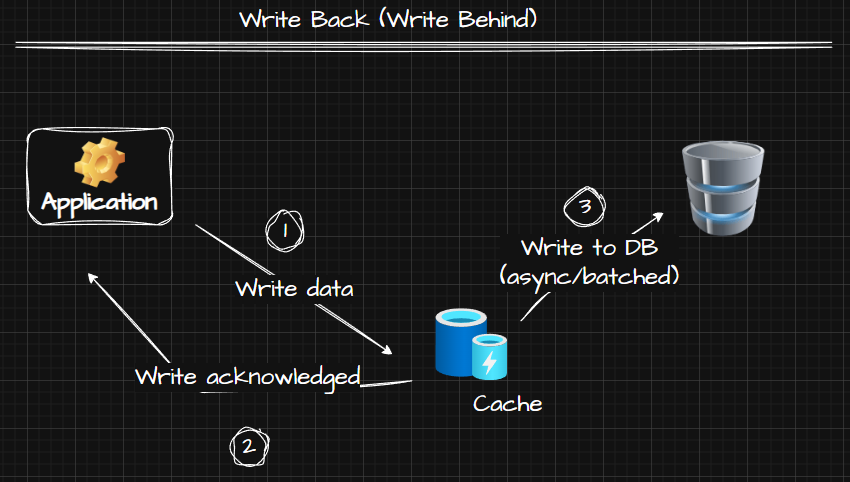
Characteristics:
- High write throughput
- Ideal for handling large volumes of writes
- Eventual consistency model
- Best for heavy write workloads
- Risk of data loss if cache fails before database write
Write Back and client-side optimistic updates follow the same principle at different layers. With Write Back, the application updates the cache first and flushes to the database later; with optimistic updates, the client updates the UI or local state first and then syncs to the server. In both cases the “fast” layer is updated immediately and the authoritative store is updated asynchronously, trading strict consistency for lower perceived latency. Tools like TanStack Query or TanStack DB use optimistic mutations on the client; that’s the same “update first, persist later” idea as Write Back, applied between browser and server instead of between cache and database.
Write Around
In Write Around pattern, data is written only to the database, and reads come only from the cache. This reduces cache write load, making it beneficial for systems with high write frequency but low read frequency.
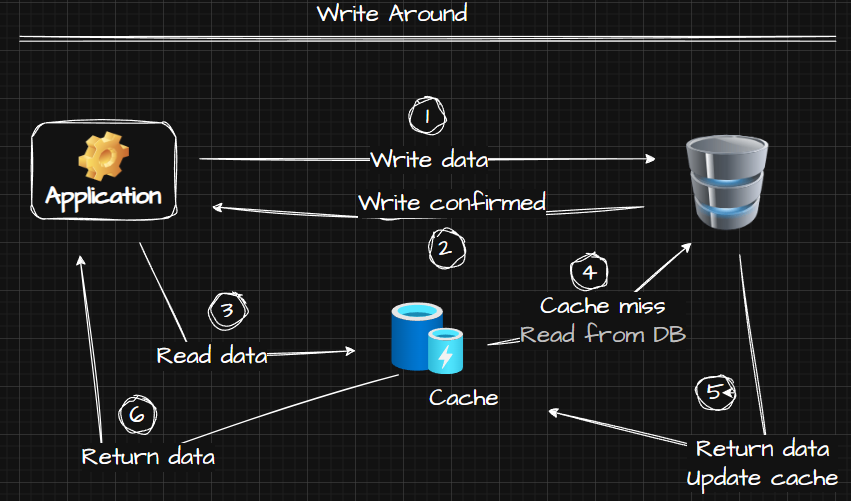
Characteristics:
- Reduces cache write load
- Ideal for high write, low read scenarios
- Cache only populated on reads
- Skips cache updates on every write
- May result in cache misses for recently written data
Pattern Comparison
| Pattern | Consistency | Write Performance | Read Performance | Best For |
|---|---|---|---|---|
| Cache Aside | Eventual | Medium | High | General purpose, flexible control |
| Read Through | Eventual | Medium | High | Read-heavy, cache warming |
| Write Through | Strict | Lower | High | Read-heavy, consistency critical |
| Write Back | Eventual | Very High | High | Write-heavy, high throughput |
| Write Around | Eventual | High | Medium | High write, low read frequency |
Common Caching Strategies
Spatial Cache
Spatial cache pulls nearby data that is often geographically or logically related. This strategy anticipates that if one piece of data is accessed, related data in the same region or context will likely be needed soon. This approach works in both single-server and distributed systems.
Use cases:
- Geographic data retrieval where nearby locations are likely to be queried
- Hierarchical data structures where parent-child relationships are common
- Graph databases where connected nodes are frequently accessed together
Temporal Cache
Temporal cache keeps frequently or recently accessed data hot. This strategy leverages the principle that recently accessed data is likely to be accessed again in the near future. This is a general caching strategy applicable to any system architecture.
Use cases:
- Web applications with frequently accessed pages or resources
- API responses that are requested repeatedly
- Session data and user preferences
Distributed Cache
Distributed cache stores data across multiple servers or nodes, allowing for horizontal scaling and high availability. This strategy is specifically designed for distributed systems and is essential for microservices architectures and large-scale applications.
Use cases:
- Microservices architectures requiring shared cache state
- High-traffic applications needing horizontal scaling
- Systems requiring cache redundancy and fault tolerance
Conclusion
Choosing the right cache pattern and caching strategy depends on your application's specific requirements. Cache patterns like Cache Aside, Read Through, Write Through, Write Back, and Write Around each offer different trade-offs between consistency, performance, and complexity. Spatial and temporal caching strategies help optimize data access patterns, while distributed caching enables horizontal scaling.
For read-heavy applications requiring strict consistency, Write Through is ideal. For write-heavy workloads, Write Back provides superior throughput. Write Around works well when writes are frequent but reads are infrequent. Understanding these patterns and strategies allows you to design caching layers that align with your application's performance and consistency requirements.