Model Context Protocol (MCP) - An Architectural Pattern for Building AI Agents
The Model Context Protocol (MCP) is an architectural pattern for designing intelligent systems powered by large language models (LLMs). By splitting an agent into four distinct layers—Model, Context, Tools, and Control Plane—it promotes modularity, scalability, and maintainability.
Note: "Model Context Protocol" is also the name of a separate, standardized protocol (by Anthropic) for connecting AI apps to tools and data. This article focuses on the architectural pattern; the protocol is covered in a dedicated article.
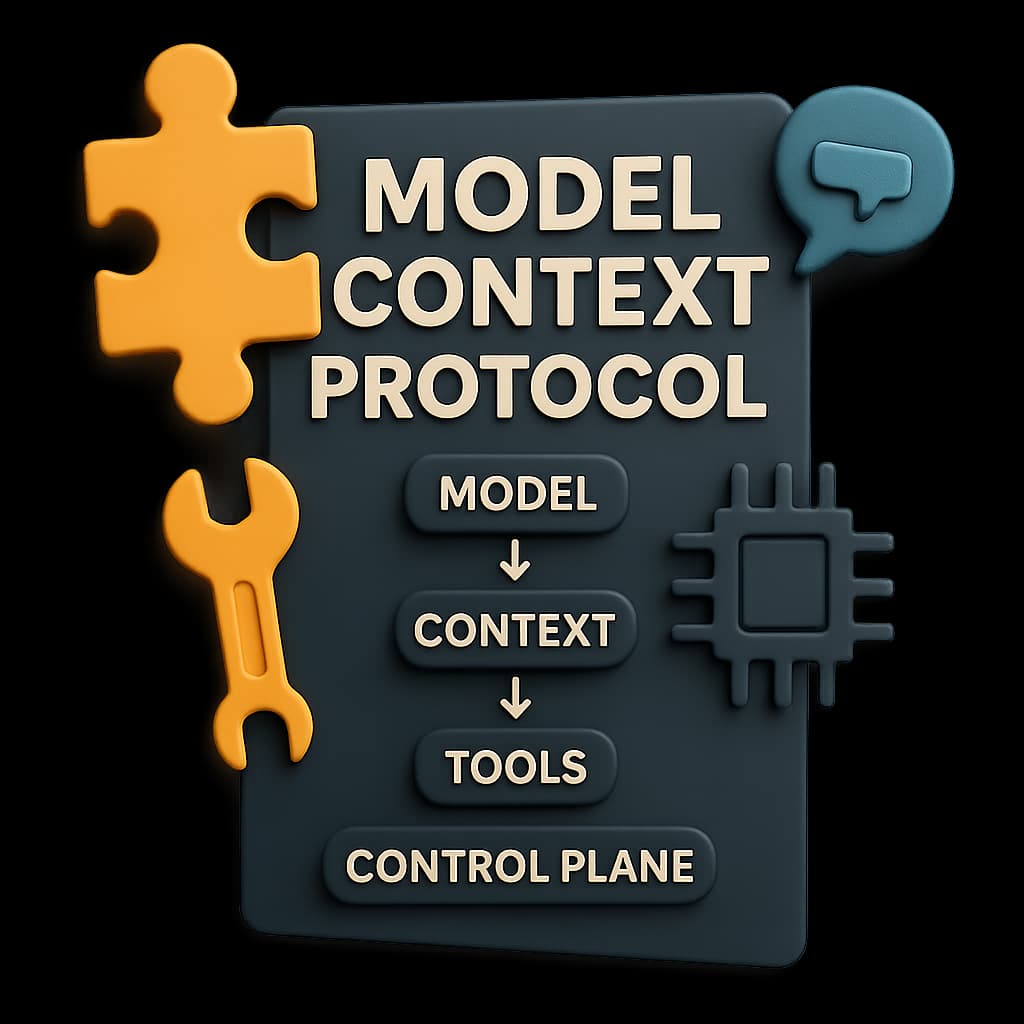
🧩 Core Components of MCP
- Model – The core LLM or reasoning engine used for decision-making and text generation.
- Context – Manages conversational history, memory, and dynamic runtime state.
- Tools – External APIs, databases, or utilities the agent can call (e.g., search, calculators, vector DBs).
- Control Plane – Provides admin access, configuration, observability, and governance for agent behaviors.
In a full system, a user-facing Client typically sends requests to a component (often called an MCP Server or orchestrator) that implements these four layers.
Architecture Deep-Dive
This four-layer architecture (sometimes called MCP-style design) interacts in a clear pipeline:
- User Input arrives and is passed first to the Context layer, which attaches relevant history and memory.
- The enriched prompt goes to the Model, which produces a candidate response or a call to a Tool.
- If a Tool is invoked (e.g., a search query), the result is fed back to the Model in a follow-up prompt.
- The Control Plane monitors each step—logging inputs/outputs and enforcing policies (rate limits, forbidden content).
Sample Workflow
Example: a user asks for stock prices.
- Context: retrieve last finance-related turns from memory store.
- Model: “What is the current price of AAPL?” → determines to call the finance API Tool.
- Tools: call getStockPrice("AAPL") → returns $175.23.
- Model: composes final answer → “AAPL is trading at $175.23.”
- Control Plane: logs the entire exchange and enforces API quotas.
🚀 Benefits of Using MCP
- 🔧 Modularity – Easily extend or replace components like tools or context memory.
- 📦 Maintainability – Clear code structure supports long-term development.
- 🌍 Integrability – Seamlessly plug in LangChain, LangGraph, or custom pipelines.
- 🔒 Governance – Introduce safety constraints and logging through the control plane.
TypeScript Code Example
The following is a minimal implementation of the four-layer architecture (Model, Context, Tools, Control Plane):
// mcp.ts

/** 1) Define core interfaces **/
export interface ContextManager {
  getHistory(userId: string): Promise<string[]>;
  appendTurn(userId: string, turn: string): Promise<void>;
}

export interface Tool {
  name: string;
  call(args: any): Promise<any>;
}

export interface ControlPlane {
  log(entry: any): void;
  enforce(entry: any): void;
}

// 2) Agent class wiring components
export class MCPAgent {
  constructor(
    private model: (prompt: string) => Promise<string>,
    private context: ContextManager,
    private tools: Record<string, Tool>,
    private control: ControlPlane
  ) {}

  async handle(userId: string, userInput: string) {
    // 2a) Enforce policy
    this.control.enforce({ userId, userInput });

    // 2b) Build prompt
    const history = await this.context.getHistory(userId);
    const prompt = [...history, userInput].join("\n");

    // 2c) Model inference
    const raw = await this.model(prompt);

    // 2d) If tool call detected, route to tool
    if (raw.startsWith("CALL_TOOL:")) {
      const [_, toolName, argJson] = raw.split("|");
      const result = await this.tools[toolName].call(JSON.parse(argJson));
      return this.handle(userId, result);
    }

    // 2e) Log & update memory
    this.control.log({ userId, prompt, response: raw });
    await this.context.appendTurn(userId, userInput);
    await this.context.appendTurn(userId, raw);

    return raw;
  }
}

// 3) Example instantiation omitted for brevity
Where MCP is Used
This architectural pattern (separating model, context, tools, and control) is common in modern agent design. Frameworks such as LangChain, CrewAI, and LangGraph use similar modular ideas—tools, context, and control planes—for building agents. It’s ideal for production-level agents, copilots, and data-driven chatbots. The official Model Context Protocol (Anthropic) is a separate standard for client–server tool and resource integration; it is covered in a dedicated article.